
Array ( [pb] => Array ( [0] => Array ( [acf_fc_layout] => pb_page_content [sidebar] => hide [sidebar_cta] =>

Want to get in touch?

Contact our experts and see how we can help you.

Contact Us

[content] =>

Why Hardware Matters

When designing a webbing or textile assembly, the webbing itself often gets the most attention.

Its width, fibre, weave construction, breaking strength, colour and finish all play an important role in how the finished product performs. But the hardware used with that webbing is just as important.

Clips, buckles, hooks, ladder locks, sliders, cord stops and other fastening components can influence how an assembly adjusts, releases, holds tension, withstands wear and performs in demanding environments.

A well-designed webbing assembly is not simply a length of tape with a fitting attached. It is a complete system where the textile and hardware need to work together.

At Bowmer Bond, we manufacture woven webbing and webbing assemblies for technical sectors including transport, commercial vehicles, safety, load restraint and industrial applications. Through this work, we understand that hardware selection is not a separate afterthought. Clips, buckles, hooks, adjusters and fastening components all need to be considered alongside the webbing itself if the finished assembly is to perform reliably.

As a webbing manufacturer, our focus is on how the textile element behaves within the complete assembly. The width, thickness, weave construction, fibre type, surface finish and flexibility of the webbing can all affect how it feeds, grips, adjusts and wears when used with different types of hardware.

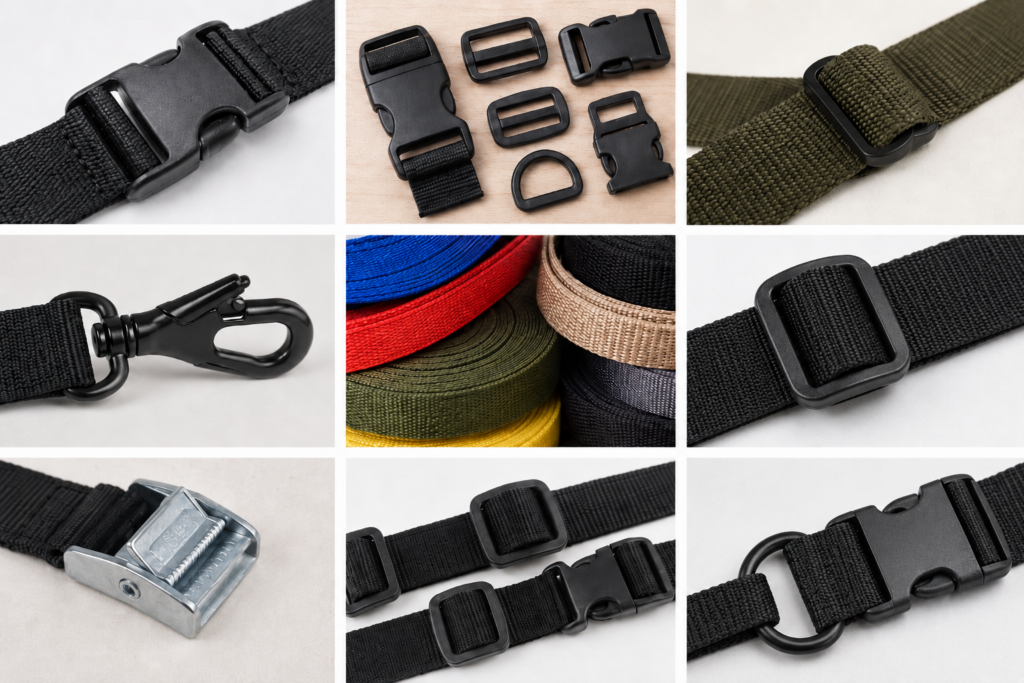
Specialist hardware ranges, such as those offered by suppliers including Butonia-Kahage, show the wide variety of fastening components available for textile assemblies. These include side-release buckles, centre-release buckles, safety buckles, ladder locks, sliders, cord stops, cord ends and hooks, with material options such as POM and nylon types PA6 and PA6.6, including specialist variants for particular applications.

For manufacturers developing webbing assemblies, the key question is not simply which buckle or clip to choose, but how that component will work with the webbing, the stitching, the intended load, the operating environment and the end user’s handling requirements.
So, what should manufacturers consider when selecting hardware for a webbing or textile assembly?

1. What does the assembly need to do?

The starting point should always be function.

A buckle used for quick release has a very different role from a ladder lock used for adjustment or a hook used to connect a strap to another structure. In some cases, the hardware needs to hold tension. In others, it needs to allow controlled movement, repeated adjustment or fast removal.

Common hardware functions include:

Adjustment
Ladder locks, sliders and tension locks can help alter strap length and control fit.

Connection
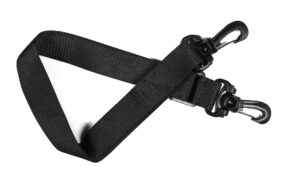
Hooks, snap hooks, rings and loops can be used to attach an assembly to another product or structure.

Release
Side-release and centre-release buckles are often used where fast opening or removal is required.

Retention
Buckles and fasteners can help keep webbing secure under expected load or during repeated use.

Routing
Rings, loops and guides can help control how webbing sits, moves or feeds through an assembly.

Selecting hardware without fully understanding the end use can lead to poor performance, awkward handling, premature wear or unnecessary complexity.

2. Will the hardware work with the webbing?

A clip or buckle should never be viewed in isolation. It needs to be compatible with the webbing’s width, thickness, surface texture, flexibility and fibre type.

For example, a densely woven polyester webbing may behave very differently through an adjuster compared with a softer polypropylene tape. Some webbings grip more readily, while others may slide more easily depending on yarn type, weave construction and finish.

Hardware slot size, bar shape and edge profile can all affect how the webbing feeds, grips and wears. If the component is too tight, it may cause friction, folding or damage. If it is too loose, the assembly may slip or feel insecure.

This is where textile knowledge becomes important. The best results often come from designing the webbing and hardware specification together, rather than treating them as separate parts.
3. Where will the assembly be used?

Hardware material matters because the operating environment matters.

Synthetic hardware is commonly produced from materials such as POM and nylon PA6 or PA6.6, with specialist options available for requirements such as flame retardation or infrared reflection.

The right choice will depend on the conditions the assembly needs to withstand, including:

  • temperature range
  • UV exposure
  • moisture and weathering
  • chemical contact
  • abrasion
  • repeated use
  • cleaning or sterilisation requirements
  • weight limitations
  • colour or visibility requirements

In transport, safety and industrial applications, these conditions are rarely theoretical. Assemblies may be exposed to cold yards, warm vehicle interiors, outdoor weather, oils, fuels, cleaning products and repeated manual handling.

A component that performs well in a light-duty indoor product may not be suitable for a rugged, high-use technical assembly.

4. How does the hardware affect strength and safety?

Not every assembly is safety-critical, but every assembly should be fit for purpose.

Where load, restraint or user safety is involved, hardware selection needs to be considered alongside webbing strength, stitch pattern, thread, assembly method and intended use. The overall strength of an assembly is only as reliable as its weakest point.

A common mistake is to focus on the breaking strength of the webbing alone, without considering how the hardware affects performance.

A fitting may introduce bend points, friction, pressure areas or stress concentrations. Stitching around the hardware can also change how forces are distributed through the assembly.

For this reason, performance testing is often essential. It helps confirm not only that the individual components are suitable, but that the complete assembly performs as expected.

5. Is it easy and practical to use?

Good hardware does more than hold a strap in place. It also affects how the end user interacts with the product.

Important questions include:

  • Can the buckle be opened while wearing gloves?
  • Is the adjuster intuitive?
  • Does the strap feed smoothly?
  • Is the release mechanism protected against accidental opening?
  • Does the hardware create noise, snagging or discomfort?
  • Can the user adjust or release it quickly when needed?

In sectors such as commercial vehicles, workwear, healthcare, emergency equipment and industrial handling, usability can be just as important as technical specifications.

A component may be strong on paper, but unsuitable if it is awkward, slow or uncomfortable in real-world use.
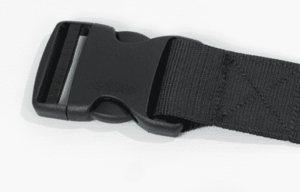
6. Can the assembly be manufactured consistently?

The choice of hardware also affects how the finished webbing assembly is made.

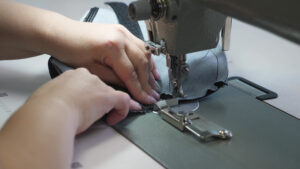
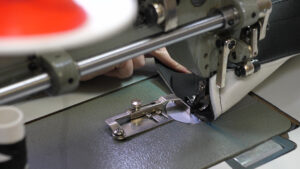
Some components require a sewn loop. Others may need punching, heat sealing, riveting, bar-tacking, folding, cutting or specialist end finishing. Hardware and textile processing, therefore, need to be considered together from the beginning.

At Bowmer Bond, this is a familiar part of the assembly development process. The finished product needs to be practical to manufacture consistently, while still meeting the required performance, appearance and handling criteria.

Hardware is part of the system

Clips, buckles and fasteners may look like small details, but in technical textile assemblies, they play a major role. They influence strength, adjustment, comfort, safety, service life and user confidence.

The most effective approach is collaborative. Webbing manufacturers, hardware suppliers, designers and end users all bring valuable knowledge to the specification process.

By considering the complete assembly from the start, manufacturers can avoid over-engineering, reduce failure risks and create products that work reliably in the field.

As a woven webbing manufacturer, Bowmer Bond brings valuable textile knowledge to the development of webbing assemblies. We understand how fibre type, weave construction, thickness, flexibility, finish and assembly method can influence the way webbing performs with clips, buckles, adjusters and fasteners.

That knowledge helps our customers develop assemblies that are practical, durable and suitable for their intended application.

When textile and hardware expertise come together, the result is not just a strap. It is a properly engineered assembly.

Speak to Bowmer Bond

Whether you are developing a new webbing assembly or reviewing an existing product, early consideration of the webbing, hardware and assembly method can make a significant difference to performance, usability and long-term reliability.

Bowmer Bond works collaboratively with customers to specify woven webbing and develop textile assemblies that suit the intended application, operating environment and end use.

For guidance on webbing selection, assembly design or how woven webbing can perform effectively within a finished textile assembly, speak to the Bowmer Bond team.

You can reach us:

By phone: +44 (0)1335 342244

By email: sales@bowmerbond.co.uk

Via our web contact form: Contact Us

[background_colour] => white [id] => ) ) )

Why Hardware Matters

When designing a webbing or textile assembly, the webbing itself often gets the most attention.

Its width, fibre, weave construction, breaking strength, colour and finish all play an important role in how the finished product performs. But the hardware used with that webbing is just as important.

Clips, buckles, hooks, ladder locks, sliders, cord stops and other fastening components can influence how an assembly adjusts, releases, holds tension, withstands wear and performs in demanding environments.

A well-designed webbing assembly is not simply a length of tape with a fitting attached. It is a complete system where the textile and hardware need to work together.

At Bowmer Bond, we manufacture woven webbing and webbing assemblies for technical sectors including transport, commercial vehicles, safety, load restraint and industrial applications. Through this work, we understand that hardware selection is not a separate afterthought. Clips, buckles, hooks, adjusters and fastening components all need to be considered alongside the webbing itself if the finished assembly is to perform reliably.

As a webbing manufacturer, our focus is on how the textile element behaves within the complete assembly. The width, thickness, weave construction, fibre type, surface finish and flexibility of the webbing can all affect how it feeds, grips, adjusts and wears when used with different types of hardware.

Specialist hardware ranges, such as those offered by suppliers including Butonia-Kahage, show the wide variety of fastening components available for textile assemblies. These include side-release buckles, centre-release buckles, safety buckles, ladder locks, sliders, cord stops, cord ends and hooks, with material options such as POM and nylon types PA6 and PA6.6, including specialist variants for particular applications.

For manufacturers developing webbing assemblies, the key question is not simply which buckle or clip to choose, but how that component will work with the webbing, the stitching, the intended load, the operating environment and the end user’s handling requirements.

So, what should manufacturers consider when selecting hardware for a webbing or textile assembly?

1. What does the assembly need to do?

The starting point should always be function.

A buckle used for quick release has a very different role from a ladder lock used for adjustment or a hook used to connect a strap to another structure. In some cases, the hardware needs to hold tension. In others, it needs to allow controlled movement, repeated adjustment or fast removal.

Common hardware functions include:

Adjustment
Ladder locks, sliders and tension locks can help alter strap length and control fit.

Connection
Hooks, snap hooks, rings and loops can be used to attach an assembly to another product or structure.

Release
Side-release and centre-release buckles are often used where fast opening or removal is required.

Retention
Buckles and fasteners can help keep webbing secure under expected load or during repeated use.

Routing
Rings, loops and guides can help control how webbing sits, moves or feeds through an assembly.

Selecting hardware without fully understanding the end use can lead to poor performance, awkward handling, premature wear or unnecessary complexity.

2. Will the hardware work with the webbing?

A clip or buckle should never be viewed in isolation. It needs to be compatible with the webbing’s width, thickness, surface texture, flexibility and fibre type.

For example, a densely woven polyester webbing may behave very differently through an adjuster compared with a softer polypropylene tape. Some webbings grip more readily, while others may slide more easily depending on yarn type, weave construction and finish.

Hardware slot size, bar shape and edge profile can all affect how the webbing feeds, grips and wears. If the component is too tight, it may cause friction, folding or damage. If it is too loose, the assembly may slip or feel insecure.

This is where textile knowledge becomes important. The best results often come from designing the webbing and hardware specification together, rather than treating them as separate parts.

3. Where will the assembly be used?

Hardware material matters because the operating environment matters.

Synthetic hardware is commonly produced from materials such as POM and nylon PA6 or PA6.6, with specialist options available for requirements such as flame retardation or infrared reflection.

The right choice will depend on the conditions the assembly needs to withstand, including:

  • temperature range
  • UV exposure
  • moisture and weathering
  • chemical contact
  • abrasion
  • repeated use
  • cleaning or sterilisation requirements
  • weight limitations
  • colour or visibility requirements

In transport, safety and industrial applications, these conditions are rarely theoretical. Assemblies may be exposed to cold yards, warm vehicle interiors, outdoor weather, oils, fuels, cleaning products and repeated manual handling.

A component that performs well in a light-duty indoor product may not be suitable for a rugged, high-use technical assembly.

4. How does the hardware affect strength and safety?

Not every assembly is safety-critical, but every assembly should be fit for purpose.

Where load, restraint or user safety is involved, hardware selection needs to be considered alongside webbing strength, stitch pattern, thread, assembly method and intended use. The overall strength of an assembly is only as reliable as its weakest point.

A common mistake is to focus on the breaking strength of the webbing alone, without considering how the hardware affects performance.

A fitting may introduce bend points, friction, pressure areas or stress concentrations. Stitching around the hardware can also change how forces are distributed through the assembly.

For this reason, performance testing is often essential. It helps confirm not only that the individual components are suitable, but that the complete assembly performs as expected.

5. Is it easy and practical to use?

Good hardware does more than hold a strap in place. It also affects how the end user interacts with the product.

Important questions include:

  • Can the buckle be opened while wearing gloves?
  • Is the adjuster intuitive?
  • Does the strap feed smoothly?
  • Is the release mechanism protected against accidental opening?
  • Does the hardware create noise, snagging or discomfort?
  • Can the user adjust or release it quickly when needed?

In sectors such as commercial vehicles, workwear, healthcare, emergency equipment and industrial handling, usability can be just as important as technical specifications.

A component may be strong on paper, but unsuitable if it is awkward, slow or uncomfortable in real-world use.

6. Can the assembly be manufactured consistently?

The choice of hardware also affects how the finished webbing assembly is made.

Some components require a sewn loop. Others may need punching, heat sealing, riveting, bar-tacking, folding, cutting or specialist end finishing. Hardware and textile processing, therefore, need to be considered together from the beginning.

At Bowmer Bond, this is a familiar part of the assembly development process. The finished product needs to be practical to manufacture consistently, while still meeting the required performance, appearance and handling criteria.

Hardware is part of the system

Clips, buckles and fasteners may look like small details, but in technical textile assemblies, they play a major role. They influence strength, adjustment, comfort, safety, service life and user confidence.

The most effective approach is collaborative. Webbing manufacturers, hardware suppliers, designers and end users all bring valuable knowledge to the specification process.

By considering the complete assembly from the start, manufacturers can avoid over-engineering, reduce failure risks and create products that work reliably in the field.

As a woven webbing manufacturer, Bowmer Bond brings valuable textile knowledge to the development of webbing assemblies. We understand how fibre type, weave construction, thickness, flexibility, finish and assembly method can influence the way webbing performs with clips, buckles, adjusters and fasteners.

That knowledge helps our customers develop assemblies that are practical, durable and suitable for their intended application.

When textile and hardware expertise come together, the result is not just a strap. It is a properly engineered assembly.

Speak to Bowmer Bond

Whether you are developing a new webbing assembly or reviewing an existing product, early consideration of the webbing, hardware and assembly method can make a significant difference to performance, usability and long-term reliability.

Bowmer Bond works collaboratively with customers to specify woven webbing and develop textile assemblies that suit the intended application, operating environment and end use.

For guidance on webbing selection, assembly design or how woven webbing can perform effectively within a finished textile assembly, speak to the Bowmer Bond team.

You can reach us:

By phone: +44 (0)1335 342244

By email: sales@bowmerbond.co.uk

Via our web contact form: Contact Us

Posted 7th July 2026 by Bowmer Bond

See more posts from Bowmer Bond

Related Articles

Clips, Buckles and Fasteners: Why Hardware Matters in Webbing and Textile Assemblies

...

Collaboration, Capability and Innovation at Techtextil 2026

...

Bowmer Bond to exhibit at Techtextil 2026!

    Bowmer Bond to Exhibit at Techtextil 2026 Bowmer Bond Narrow Fabrics will be exhibiting at Techtextil 2026, the...

The Future of Webbing in Retail & Logistics

...

Want To Get In Touch?

Whatever your Narrow Fabric requirements, we are sure we can help.

Please complete our   Contact form

A member of the Sales team will contact you.

Privacy Overview

This website uses cookies so that we can provide you with the best user experience possible. Cookie information is stored in your browser and performs functions such as recognising you when you return to our website and helping our team to understand which sections of the website you find most interesting and useful.